AI for climate resilience meets local know-how
A visit to remote islands in the Indonesian archipelago, where artificial intelligence experts are working with coastal communities to strengthen climate resilience and build digital expertise. GIZ is supporting this special initiative.
When the Indonesian province of Aceh was devastated by the tsunami that followed the gigantic earthquake of 26 December 2004, one of the hardest hit regions was Pulo Aceh. Survivors recall how the huge waves of the Indian Ocean swept away everything in their path. The disaster claimed the lives of 70 per cent of the island group’s population – leaving just 1,400 survivors.
Twenty years on, Pulo Aceh is once again displaying its natural beauty. These tiny islands in the far west of Indonesia are now as lush and vibrant as ever – with unspoiled beaches home to unique fauna, sea turtles gliding through the waters and the hillsides below the historic lighthouse awash with the distinctive purplish hues of the native bak rubek flower.
The local population has been working with the government to rebuild the devastated islands. But now they are confronted with new challenges. A particular problem facing Pulo Aceh is the increasing impact of climate change. For generations, the ocean has provided the islanders with a livelihood. Today, those involved in the fishing industry have to contend with fickle weather and declining catches. ‘The waters have become unpredictable,’ says 28-year-old Muhajirin, who works in a local cooperative. ‘Due to rising sea temperatures, the fishing grounds now lie further offshore and the coral reefs – which provide a natural habitat for fish – are becoming bleached.’

‘The waters have become unpredictable.’
Like Pulo Aceh, the entire Indonesian archipelago is especially vulnerable to rising sea levels, extreme rainfall and flooding. According to the World Bank Group’s Country Climate and Development Report (CCDR), around 70 per cent of natural disasters in Indonesia can be linked to climate change. With a population of around 283 million, the South-East Asian country is among those most impacted by climate risk.
A pilot project for climate resilience
Adapting to climate change is a top priority. This is crucial to protect Indonesia’s population, its ecosystems and economy. International partners are collaborating with local initiatives to find innovative solutions. In Pulo Aceh, the Deutsche Gesellschaft für Internationale Zusammenarbeit (GIZ) GmbH is working with local partners to promote an initiative for a blue economy. The aim of a blue economy is to strengthen the economic basis of people living in coastal regions and at the same time preserve the health of this endangered ecosystem. The pilot project in Pulo Aceh involves local coastal communities and makes use of artificial intelligence (AI).


The pilot project in Pulo Aceh is part of the FAIR Forward – Artificial Intelligence for All initiative, which works with the partner countries of Ghana, India, Indonesia, Kenya, Rwanda, South Africa and Uganda. The initiative provides access to training data and AI technology to support local innovation, develop local digital skills and create a policy environment for values-based AI and improved data protection. The work in this remote coastal region of Indonesia is an initial attempt to embed AI in the blue economy. Energy-efficient AI models and networked sensors are being used to create sustainable digital solutions that are directly customised to the needs of coastal communities.The project was initiated following a request by Indonesia’s National Development Planning Agency to develop AI solutions for coastal areas.
FAIR Forward is implemented by GIZ on behalf of the German Federal Ministry for Economic Cooperation and Development.
‘We’re getting the government, the scientific community and local people around the table to try out various approaches. This enables us to jointly develop customised AI solutions for Indonesia’s coastal regions,’ says Karlina Octaviany, AI expert at GIZ’s FAIR Forward – Artificial Intelligence for All programme. The approach requires the collection of data at all levels.
The Indonesian Agency for Meteorology, Climatology and Geophysics contributes climate data at macro level – that is to say, data that relates to the country as a whole. But much of the data required for climate adaptation has to be collected at the micro level – locally and at as many sites within the archipelago as possible. This is the only way to create a sufficiently dense data network. Custom-built buoys are being used in Pulo Aceh to trial a low-cost approach.


‘We’re getting the government, the scientific community and local people around the table to try out various approaches.’
Local residents are being actively integrated into the project and invited to help develop a joint solution. In Pulo Aceh, for example, fishermen have been contributing their expertise to help identify the ideal locations for Solitude buoys. ‘They know exactly which waters are accessible, where sensors can be positioned and which areas must remain untouched. These rules are part of a traditional system of coral reef protection that has been passed down over many generations,’ explains tech developer Rois Solihin.
Engaging with people in this way takes more time than just setting up a measuring instrument. But the team is convinced that coastal communities will be more accepting and protective of digital technologies if their own know-how is included and valued.

‘This project shows how artificial intelligence can be used in a targeted manner to support sustainable development in coastal regions. By providing open access to AI technologies, we empower local stakeholders to develop innovative solutions to their specific challenges.’
At the same time, people in the coastal villages receive training to help them understand the project’s technical aspects and develop their digital literacy. At a community centre in Pulo Aceh, women and men have come together to learn how to operate devices and apps and find out more about artificial intelligence. Ulva Zahra, a teacher, is delighted with her newly acquired skills.
‘I had no idea that AI and social media could be so beneficial. I use both to help me create more interesting teaching materials, express myself more clearly as a teacher and deal more effectively with the children’s temper tantrums,’ says the 25-year-old, who also wants to put her digital skills to use in future promoting her home region. ‘I often share posts on social media about Pulo Aceh to get people interested in visiting us.’
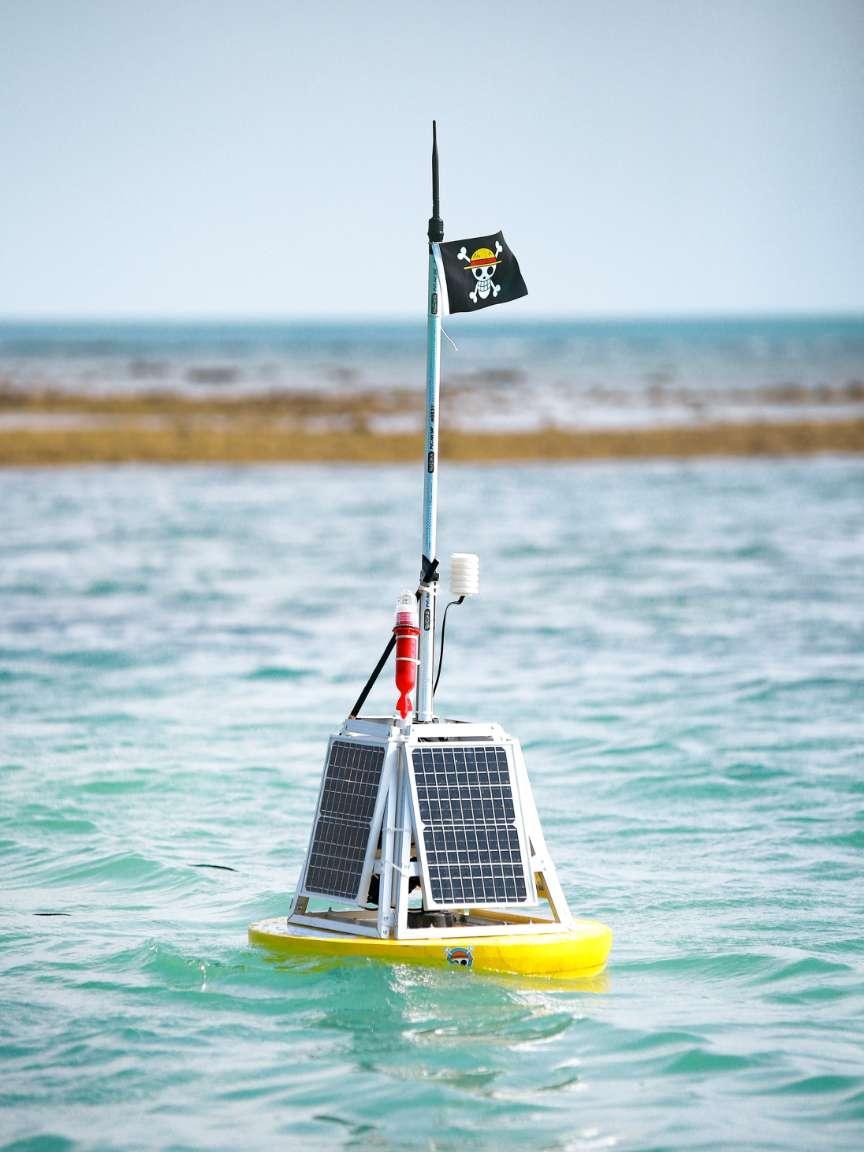
Solitude is a DIY weather station. It is based on simple technology to keep costs down. The device has a circular buoy as its base and is equipped with around 67 sensors, solar modules, an antenna, temperature sensor, GPS and a small box that serves as a computer/router. In addition to taking temperature readings, the prototype collects data on humidity and the levels of salinity, acidity and dissolved oxygen in the coral reef ecosystem. It then sends this data to the cloud server. The data are analysed and processed and provide a basis for machine learning (ML). ML models are used to analyse these complex climate processes, predict temperature trends and react to changes at an early stage. By using Internet of Things (IoT) technologies and low-resource artificial intelligence – AI that consumes little energy and is trained on local computers – Solitude is capable of delivering key insights for coastal communities. It enables the local population to adapt better to the consequences of climate change.
For entrepreneur and occasional fisherman Jar Suwardi, the training course has taught him how to find weather data to identify when to fish in increasingly unpredictable weather conditions. ‘We’ve also been working on ways to create business models and programmes that boost the local economy. AI has the power to improve the livelihoods of local people,’ says the 29-year-old.

Karlina Octaviany too is impressed by the way the people of Pulo Aceh have positively embraced the training programme. Enthusiastic teachers can hardly wait to teach their secondary school students about AI and its beneficial uses. ‘We don’t want artificial intelligence to be seen as a top-down technology. We want it to grow with the community and meet their specific needs,’ says Octaviany. Such enthusiasm among the learners in Pulo Aceh is testimony to the success of this approach.


