Beyond the coffee bushes
A novel approach to protecting the climate and the environment in Costa Rica – join us on a finca that produces more than just climate-friendly coffee.
You can see Lizeth Jiménez and Celeste Aguilar from some distance away. In their colourful jumpers, they stand out from the lush green landscape that surrounds them. The two women pull and pick, weed and clean in rectangular fields where the plants are almost a metre high. You can smell mint from somewhere off to the right, and from the left comes the scent of oregano. The women smile, wave and dive back into the dense greenery.
It’s early morning in late October at the foot of the Turrialba volcano in eastern Costa Rica. Here in the village of Aquiares, 1,000 metres above sea level, the clouds envelop the hills and offer some protection from the sun, which is pretty intense even at eight o’clock. Surrounding the village, and bearing the same name, is Aquiares coffee farm, the largest contiguous finca in this Central American country.
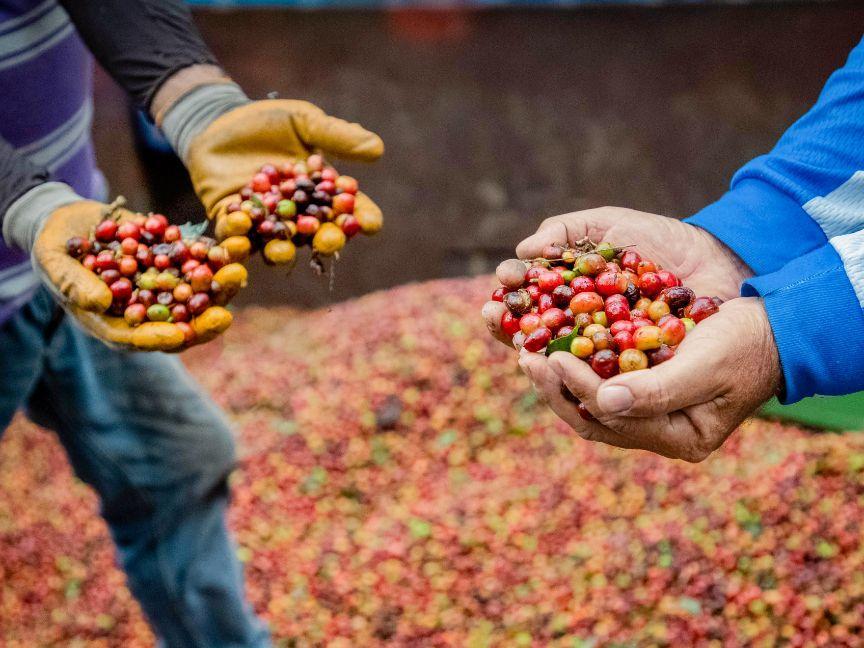
The coffee bushes stretch across 620 hectares of the rolling hills and down into the river valleys. At this time of year, the bushes are full of plump, purple coffee cherries. At dawn, men and women head out into the fields to fill their baskets. October and November are the peak months of the harvest season.


Fields of medicinal plants bordering the coffee plantation
But Lizeth Jiménez and Celeste Aguilar are not there to pick coffee cherries. Two years ago, fields of medicinal plants were established on the edge of the coffee plantation. Over an area roughly the size of three football pitches, the main crops here – alongside sage, tarragon, mint and thyme – are oregano and juanilama, a native Costa Rican herb with an antispasmodic effect. Just like oregano, which has antiseptic and expectorant properties, it is used to produce an organic cough syrup. The Plantas Medicinales (medicinal plants) project was set up in cooperation with the Costa Rican pharmaceutical company Lisan, which specialises in natural medicine and sources a large proportion of its raw materials from Aquiares.
Wearing thick grey gloves, 42-year-old Lizeth Jiménez cleans some leaves from an oregano plant. When she talks about her work, her face lights up with a broad smile: ‘All my life, I’ve only ever picked coffee. Now I’m learning about medicinal plants and how to make essential oils and soaps. That makes me feel important.’ Like her colleagues, Lizeth comes from Aquiares and has dedicated her life to her family and coffee. ‘But there was only ever work for us during harvest time,’ she says.
A steady income for women
Lizeth is one of ten women who work on the medicinal plant farm in Aquiares. They sow, harvest, prune and tend the plants, but they also learn how to make products from them – including soaps, gels and essences. What’s particularly good about the medicinal plant project is that the women from the village now have a permanent job and receive a steady wage. ‘It’s almost like a new life,’ she says happily. ‘I get up in the morning and look forward to work. I feel like I’m part of the whole thing.’
Thanks to that secure income, some of the women are even developing ideas for new career opportunities. Take Celeste Aguilar, for example, who became a mother at the age of 16. Now 24, she is studying to become an agronomist. Celeste stresses how much more confident she feels thanks to her job with the medicinal plant project: ‘It shows the men that we can do more than just dig holes.’
So how did medicinal plants end up on Costa Rica’s largest coffee farm?
The owners of the Aquiares coffee farm took the decision some years ago to focus on sustainable and environmentally friendly production and also looked at ways of diversifying their business. ‘There was such a tremendous need after the pandemic that we quickly developed several project ideas,’ explains Diego Robelo, Managing Director and co-owner of Aquiares. ‘And we were lucky that Lisan needs the leaves of the eucalyptus we plant and tend on our coffee plantation for its cough syrup.’ As part of a wider strategy of sustainable and diversified cultivation, the trees also provide shade and store CO2.
The collaboration with Lisan gradually expanded, and the idea of medicinal plant fields was developed. Aquiares bought and repurposed land near the village that had been exhausted after years of coffee-growing, giving women the chance to earn a steady income that was not dependent on the usual harvesting cycles. ‘The idea is not only sustainable and green,’ says Robelo. ‘It’s a niche business opportunity, too.’ It’s also an idea that invests in the economic participation of women in the region – a win-win situation at many levels.


Partnership with the private sector
The Deutsche Gesellschaft für Internationale Zusammenarbeit (GIZ) GmbH has been working with Aquiares for many years and supported the finca’s plans for climate-friendly coffee production. GIZ also advised on the use of organic fertilisers and worked with Lisan to train the women in agriculture and organic production. ‘We even received direct support to purchase a boiler and a distillation plant for the essential oils,’ Robelo points out. ‘Without GIZ, we wouldn’t have been able to get started so quickly.’ The success of the Plantas Medicinales project is also down to the collaboration with Lisan – another great example of a public-private partnership (PPP) with a development focus.
‘Without GIZ, we wouldn’t have been able to get started so quickly.’

Why protecting the climate is also a recipe for commercial success in Costa Rica
What’s more, the medicinal plants fit in perfectly with the finca’s wider business strategy. Aquiares has been producing CO2-neutral coffee since back in 2014 and has been awarded the Costa Rican Government’s Carbono Neutral label. The company’s 35-year-old managing director, Diego Robelo, was one of the first to recognise the commercial benefits of producing sustainable coffee while also protecting the climate. ‘We are able to show that Costa Rica can not only produce high-quality coffee but also reduce its emissions in the process,’ he says. ‘That’s a perfect combination in today’s world, given that consumers increasingly want to know where and how their product originated.’
Diego Robelo’s vision of an environmentally friendly and commercially successful finca that looks beyond coffee production is typical of Costa Rica. The Central American country has long had green ambitions and is making every possible effort to shift its agricultural production, transport systems and even parts of its industrial base to low-carbon or carbon-neutral models. Here in Aquiares, at the foot of the Turrialba volcano, among the coffee bushes and the fields of medicinal plants, that goal has moved a little bit closer.
Climate on track
Costa Rica is leading the way in climate action. GIZ is supporting the country in achieving its climate targets. One example is in coffee production, with the ‘Transforma-Innova’ programme financed by the International Climate Initiative and the European Union. The medicinal plant project in Aquiares is an example of a socially just transformation process. It was commissioned by the German Federal Ministry for Economic Cooperation and Development (BMZ) as part of the programme ‘Ideas for Green Recovery in Central America and the Dominican Republic’.
Contact ‘Transforma-Innova’: Alberto Vega-Exposito; Contact ‘Ideas for Green Recovery’: Kathrin Russner
