‘Our mission is relevant and valid’
Interview with Mark Robinson, Executive Director of the Extractive Industries Transparency Initiative (EITI), an international organisation and GIZ partner that works against corruption in a highly profitable sector


Mr Robinson, please tell us in a few sentences what your organisation is all about.
The EITI is a global initiative, designed to improve the governance of the extractive industries. It does so mainly by generating data and information on all aspects of the value chain. Thus, we try to identify and rule out corruption and find ways to improve the sector, because we believe that natural resources belong to the citizens of a country and should benefit them. The work is based on a multi-stakeholder model: in each EITI member country, governments, private companies, and the civil society are brought together to create a mechanism for the use of that respective data.
So, you try to improve a sector by shedding light on its practices?
Exactly, it’s all about transparency and information sharing – as the title of our initiative reveals. By making practices visible we initiate change.
At the core of EITI are the multi-stakeholder groups. How do they work?
Representatives from different constituencies get together, build a multi-stakeholder group and decide on the modalities and the level of reporting in each country. They are free to decide how to do this in line with the reporting framework we call EITI Standard. Together, they compile the respective information on the sector and submit it to EITI.
How much of the extractive industry do you cover in each country by rule of thumb?
On average, 99 per cent, but no less than 95 per cent of the sector is covered. So, what we do is relevant and valid.
What if a country does not comply with the EITI Standard? Can you apply sanctions?
Not in a direct sense. But the Board can suspend countries. There are two ways to do that: one is in response to conditions of political instability and conflict, like a military coup or an insurrection which closes civic space. Then the EITI cannot function effectively, for example, if the multi-stakeholder group is not allowed to meet. That can lead to suspension, as happened with Myanmar and Afghanistan. The other kind of suspension is usually temporary when a country does not submit its report on time, as is happening right now with Albania or Peru. But this is usually lifted once reports are submitted.
Are countries also withdrawing from EITI by themselves?
That happens as well. For instance, the USA withdrew under the Trump administration. Azerbaijan withdrew in 2017 because it knew that it would get suspended because of civil society constraints. But countries might also rejoin, as was the case with Niger. We always keep the doors open and hope countries come back.
Is the information countries turn in verified?
On average, every three years we conduct a Secretariat-led assessment of progress against the requirements of the EITI Standard which we call Validation. This is a very intensive exercise during which we interview all stakeholders involved and sometimes arrange in-person country missions. Then we produce a report that we share with the multi-stakeholder group, incorporate their feedback, share it with our Board and then publish the results. These progress reports get a lot of attention from the media. It is an important accountability tool. Countries don’t like to get bad report cards but we encourage continued progress and a race to the top.
You have 56 countries aboard now. Would you say they encompass the most important extractive industry countries?
There are some important resource-rich countries missing, like Australia, South Africa, Brazil, Russia and China. Yet, in addition to the 56, there are ten more countries considering joining right now. Chile, for instance, recently declared its intention to join, hopefully this year.
Is it feasible to say that autocrats and dictatorships avoid EITI?
The EITI requires respect for civil society space as a condition for signing up. In most authoritarian environments, that space does not exist, so it is difficult for them to join.
What is your membership goal for the next years?
We want to bring the most significant producers of natural resources into the EITI. That would be about 70 countries. With 56 members, we now have about two thirds of them.
What have you achieved in the 20 years of your existence?
We have made quite a difference, but our job is not done. Are there still problems of governance and corruption in the extractive sector? Sadly to say, yes. But we have seen some real progress in quite a number of countries, among them Senegal and Armenia. We also aim to support countries in raising revenues from their extractive sector for the benefit of their citizens. That’s also part of our core mission. Here we have some real improvements. Together with GIZ, we commissioned a study in Ghana that helped to identify over 700 million dollars in revenues that had been missed in the accounts. In the Democratic Republic of the Congo, a Chinese company had not met its investment commitments in terms of building roads and hospitals as part of a large mining contract. This was highlighted by EITI reporting and then seven billion dollars of additional investment was mobilised.
What role does GIZ play for you?
GIZ is an important partner for us because it has strong technical capacity on the ground. It has helped diverse countries to report under the EITI. There is a superb example from Mauritania where the GIZ technical team supported the government to produce probably one of the most effective and progressive systems of data-driven reporting we know. And there is also a lot of interchange and sharing of insight and experience between our two organisations.
What are some of your future challenges?
In addition to getting more members we need to focus on local communities and how they can be actively engaged as potential beneficiaries. Much of the land on which mining is found is owned by indigenous communities or land-dependent communities. They need to be involved in the discussions concerning jobs, services and distribution of revenues. We are also sharing lessons from extractives transparency with countries and companies for the renewable energy sector. These two insights demonstrate that EITI is not static but developing constantly in response to a changing context.
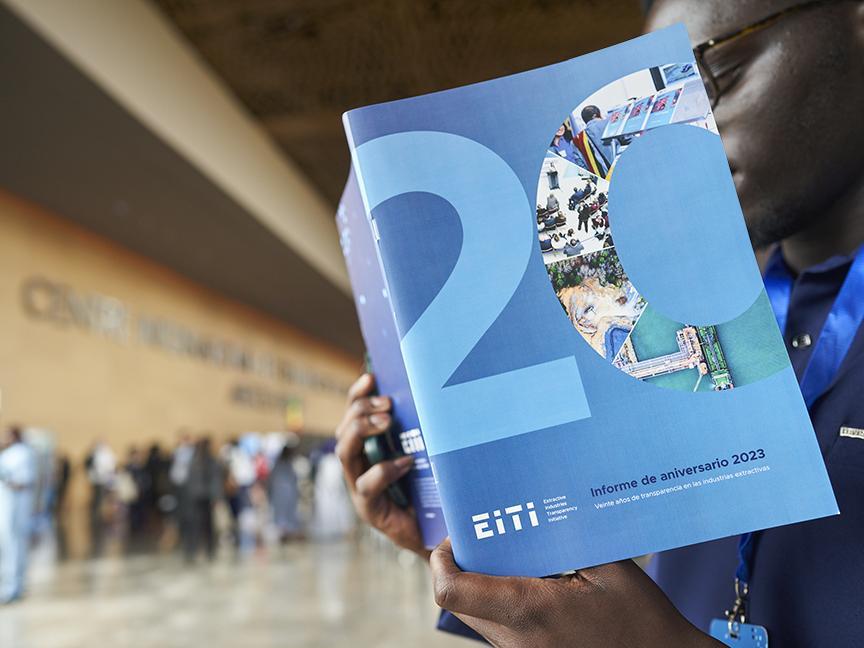
Information as change maker
The Extractive Industries Transparency Initiative (EITI) was founded in 2003 as a response to a campaign by a couple of international NGOs. They criticised deep corruption problems in major producing countries around the world. Tony Blair, Prime Minister of the United Kingdom at that time, called for the creation of a global initiative to address this problem by increasing the transparency of the sector. EITI started with 9 countries, Germany being one of them; now it has 56 members. The International Secretariat is located in Oslo. The EITI globally has about 800 staff, of which roughly 50 are based in Norway; the rest work in EITI member countries. It is led by an Executive Director and governed by the EITI Board whose 20 members come from governments, civil society, industry and institutional investors. They take decisions by consensus. The EITI’s mission is to promote understanding of natural resource management, strengthen public and corporate governance and accountability, and provide data to enhance public understanding of the extractive sector.