‘GIZ is valued as an important partner of the WTO’
Less bureaucracy, more growth: Birgit Viohl from the World Trade Organization (WTO) explains how dynamic trade can be successful – and how GIZ supports states across the globe in making customs clearance faster.


Ms Viohl, international trade is regarded as a driver of economic growth and development – in the Global South as well as in Europe. What slows down trade and investment?
First, there are short-term factors that cause delays. For example, sudden increases in customs duties or transport problems. As a result, companies seek to spread their supply chains across multiple countries to reduce dependencies.
In the long term, trade and investment is largely hampered by unstable framework conditions: a lack of transparent rules, frequent changes and the uncertainty of whether authorities are consistent, fair and efficient. Countries that invest systematically in the modernisation and simplification of administration and in reliability and legal certainty reduce trade barriers. They can thus strengthen their companies’ competitiveness and promote international trade.

The objective of the Trade Facilitation Agreement (TFA) of the World Trade Organization (WTO) is to reduce costs in international trade. This primarily involves making customs procedures standardised, digitalised and more transparent. The Agreement entered into force in 2017. Since then, 162 members of the WTO have signed the Agreement, including Germany. Of these signatory states, 123 are considered developing countries.
The Trade Facilitation Agreement Facility ensures that less developed countries in the Global South also have access to development partners and financing, so that they too can fully benefit from the advantages of the Agreement.
Trade facilitation, as set out in the WTO’s Trade Facilitation Agreement (TFA), sounds very technical at first. What does it mean exactly?
Administrative procedures need to be simplified and digitalised as a whole, including to cut costs. In many countries, staff at companies have to fill out documents themselves by hand. This is very time-consuming. In Sri Lanka, for example, we identified up to 11 discontinuities when issuing export certificates. These are moments where staff must intervene in the process themselves to present documents, make payments, add missing information and ensure that a certificate gets processed.
An example from Tunisia shows how this can be changed. In Tunisa, GIZ was able to advance digitalisation for the movement of goods. The use of electronic pre-arrival notices can save 21 minutes per document. If you apply this to ten thousand certificates issued each year, a significant amount of time and money can be saved.
How do the WTO and GIZ work together in general to reduce trade barriers?
The WTO sets the framework conditions. GIZ, with its expertise and mandate, is responsible for implementation and organisation. Even before the Agreement, GIZ assisted many countries in reducing trade barriers. Since 2017, it has provided targeted support with implementation of the TFA. GIZ is valued across the globe as an important partner of the WTO.
It has also been a direct implementation partner for the TFA since 2026. Through this partnership, we can finance smaller reform projects for the Agreement. We currently cooperate with GIZ in Kenya, Kyrgyzstan and Madagascar.
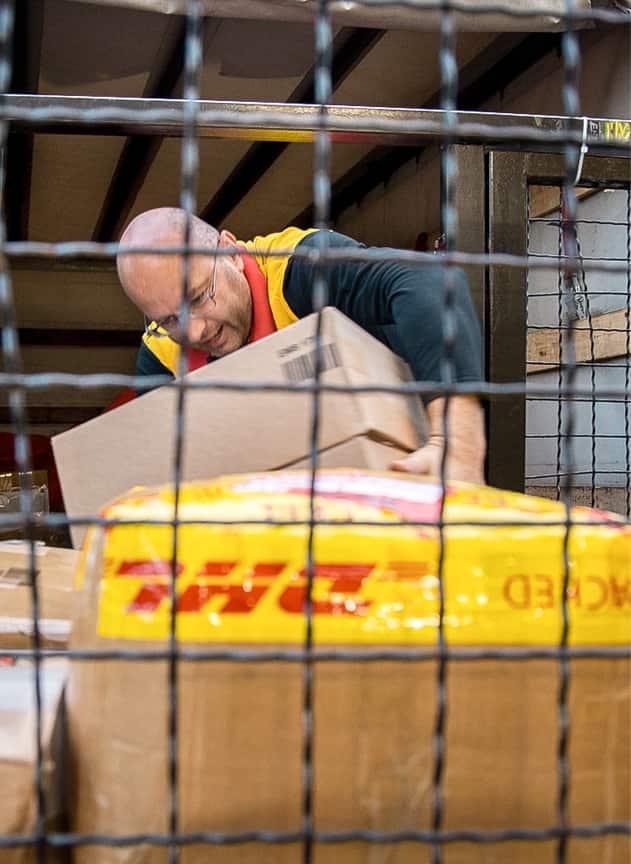
The Partnerships for Sustainable Trade Global Programme reduces bureaucracy in international trade. This has multiple benefits: partner countries become stronger economically, people can improve their living conditions, and German and European companies can open up markets more efficiently.
Working side by side with authorities and the private sector, GIZ implements trade facilitation on behalf of BMZ – in close cooperation with regional and bilateral projects in the partner countries. The global programme has been cofinanced by the EU since 2025 and, since 2026, in addition by the WTO.
In the case of Ukraine, for example, trade facilitation contributes to food security for the poorest countries. Many of them continue to source wheat from the breadbaskets of Ukraine. Electronic certificates known as ePhytos make grain trade faster, cheaper and more secure.
Together with German logistics company DHL, GIZ ensured that express shipments like medicines cleared customs more quickly in 11 countries. Through pre-arrival processing in Montenegro, for example, the majority of express shipments can now be released within an hour.
GIZ is making cross-border trade faster, cheaper and more transparent in 24 countries already. It is a partner of the Global Alliance for Trade Facilitation, which is financed by the EU, BMZ, Canada and Sweden.
Contact: Susanne Wolfgarten
What impact do simplified border procedures have on investment made by private companies in developing countries and emerging economies?
OECD studies show a positive impact on investment when international rules are followed. According to the studies, transparency, modern procedures and fast customs clearance at borders send a positive signal fundamentally.
Another concrete impact can be seen with regard to investment in trade-related services, particularly in the logistics sector and digitalisation. Modern border procedures only work in an effective private sector. Professionalisation and modernisation of the private sector is often driven forward by domestic and foreign investment. This results in a positive correlation: trade facilitation promotes investment and investment facilitates improved and more efficient border procedures. Both aspects reinforce each other.
In your view, what concrete value does more efficient global trade have for European actors?
Trade facilitation leads to reduced costs and less uncertainty for German and other European companies when opening up new markets. Barriers are dismantled and it is easier to clear goods from customs in Africa, for example. The WTO has a stabilising effect because the countries have undertaken to implement the same standards. Market access is thus easier to calculate and plan.
‘Trade facilitation reduces barriers for German companies, too; it is easier to clear goods from customs in Africa, for example.’
What are the greatest challenges for countries in the Global South with regard to the TFA?
First of all, it is a huge success that 123 developing countries have undertaken to implement all provisions of the Agreement. At the same time, the Agreement is very complex: it covers 39 individual measures that must be carried out by various different ministries and authorities in the countries. The full impact of the Agreement will be achieved only when the countries in the Global South can implement everything. And that will take time. The majority of the countries have set 2030 as a deadline.
The challenges include mobilising expertise and financing reforms as well as changes in the culture and conduct of authorities and the private sector. Open communication, fair and equal treatment, partnerships and trust need to be established in the long term.