Africa’s path to fairer land rights
Secure land rights promote development and stability. With this in mind, a network of excellence is focusing on better training, applied research and close cooperation between researchers and policy-makers. Together with the African Union, GIZ is taking action to drive sustainable progress on land issues.
Africa offers an impressive array of landscapes – from vast deserts, open savannah, dense rainforests and fertile river valleys through to high mountains and diverse coastlines. Yet the regulations governing who owns the land, who can use it and who actually makes the rules are not always formally defined. Insecure land rights slow investment, hold back the transition to sustainable forms of agriculture and fuel conflict. It is an issue that often leaves under-resourced administrations powerless.
To address these challenges, the Network of Excellence on Land Governance in Africa (NELGA) draws on the combined strengths of researchers, policy-makers and practitioners. For the African Union, it is a building block on the path towards its Agenda 2063 vision entitled ‘The Africa We Want’.
The Network of Excellence on Land Governance in Africa (NELGA) consists of more than 70 universities and research institutions from all over Africa. It links academia, policy and practice in the fields of land rights, land policy and land administration and was initiated by the African Union. On behalf of the German Federal Ministry for Economic Cooperation and Development (BMZ), GIZ has teamed up with a range of partners to support NELGA.
Knowledge network for a fair future
Use the links to find out more about the Network of Excellence on Land Governance in Africa.
Chaimaa Erreddaf
Moroccan Urban Planner
‘Land issues are key to peace and development’
Ibrahima Diallo, a professor of land law and NELGA’s coordinator in West Africa, spoke to us about developing a comprehensive academic study programme on land issues.
Ensuring that policy decisions are based on evidence
Dr Janet Edeme from the African Union Commission in Addis Ababa on the role of NELGA for the African continent.
Consolidating knowledge, enabling reform
NELGA has four main objectives:
- To strengthen education and training – through new and improved study programmes on land governance
- To promote networking – by bringing together African researchers in regional and continental structures
- To support policy research – providing answers to specific land policy challenges
- To provide data – making reforms measurable and verifiable.
NELGA has already achieved tangible results. 29 study programmes have been updated in 23 countries, from land administration to regional planning. NELGA experts have a significant influence on policy decisions all over Africa, particularly on land policy in Chad, Ghana, Namibia, Senegal, South Sudan and Zambia. In Ghana, for example, two NELGA experts are supporting efforts to update land policies dating back to 1999. In five countries, NELGA experts have also contributed to the development of national investment plans that reflect the importance of land rights for agriculture.
Scholarships through the German Academic Exchange Service
More than 160 scholarships – including 70 for doctoral studies – have been awarded by the German Academic Exchange Service (DAAD). One of the beneficiaries is Frieda Nangolo, who was awarded a scholarship for a master’s course in geosciences and spatial science at Namibia University of Science and Technology.
Frieda grew up in a village called Onkani in northern Namibia. After leaving school, she moved to the capital Windhoek to complete a bachelor’s course at Namibia University of Science and Technology. Following an internship with the city council, she decided to broaden her knowledge. The scholarship covered her studies, living costs and learning materials.
‘The time I spent studying with the support of NELGA and the German Academic Exchange Service was a rewarding experience. It posed challenges and revealed sides of me I didn’t know existed,’ remembers Frieda. Thanks to this approach, NELGA is raising the profile of women and young people on issues related to land – and creating new career opportunities for many African experts.
Learning with practical application
In addition to academic learning, NELGA is committed to vocational training. Over 300 experts – almost half of them women – have already completed a seminar on the political economy of land governance in Africa. An online course on the resolution of land conflicts has also made knowledge on this topic available outside the classroom. To date, more than 3,500 experts have taken part in further training on land rights.

Key to investment and economic development
Fair and secure land rights in Africa are not only crucial for the countries in question; they are strategically important for Germany and Europe, too. They provide the basis for economic development, food security and conflict prevention – factors that promote regional stability. ‘Land issues are key to peace and development,’ emphasises Ibrahima Diallo, a professor of land law in Senegal and NELGA’s coordinator in West Africa.
Furthermore, many African countries are key partners when it comes to the agricultural products and raw materials that are important for European markets and supply chains. Robust land policy facilitates sustainable investment and provides planning certainty for farmers and municipalities. It also strengthens economic cooperation and collaboration on global issues such as climate resilience and biodiversity.

now have national investment plans for agriculture that also consider land rights – thanks to input from NELGA experts.
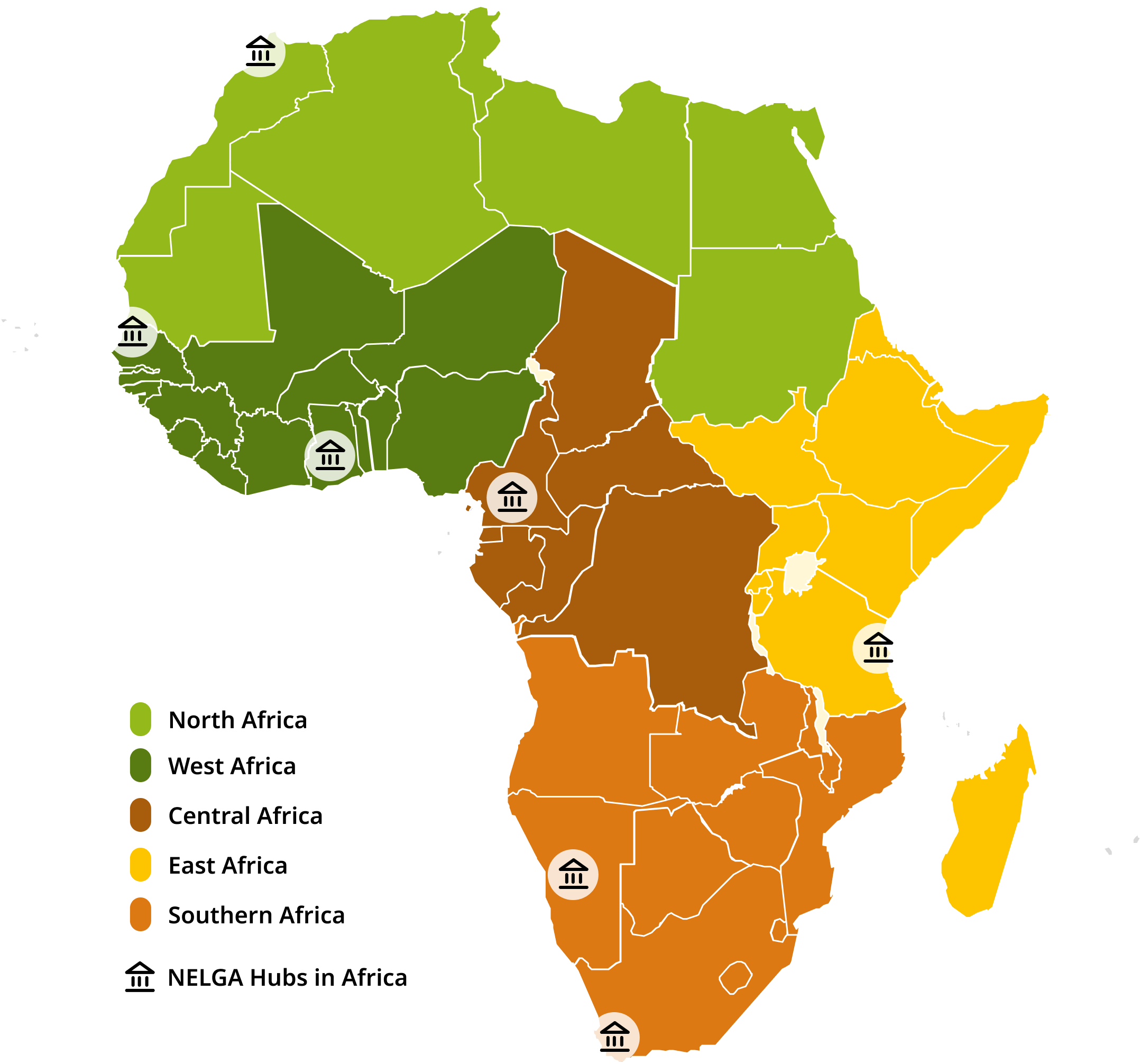
Institut Agronomique Vétérinaire Hassan II (Morocco, in charge of the North Africa region)
University Gaston Berger (Senegal, in charge of the French-speaking West Africa)
Kwame Nkrumah University of Sciences and Technology (Ghana, in charge of the English-speaking West Africa)
University of Yaoundé I (Cameroon, in charge of Central Africa)
Ardhi University (Tanzania, in charge of East Africa)
Namibia University of Science and Technology (Namibia, with responsibility for Southern Africa)
Institute for Poverty, Land and Agrarian studies (South Africa, in charge of technical priorities)


