Remaining steadfast
Why former football star Neven Subotic has been interested in water issues in Africa for years, and why he considers fundamental criticism of international cooperation excessive.

‘Give it all you’ve got,’ is Neven Subotic’s motto for life. And he has truly lived by it, previously as a footballer and now as a philanthropist. He was an exceptional athlete and today he demonstrates extraordinary social commitment. Whilst others seek their fortune as coaches or managers after retiring from active play, Subotic has turned his back on football entirely. ‘I don’t even watch football matches on TV anymore.’
Instead, he is far too passionate about his new role. Neven, as he is affectionately known, is fully focused on his humanitarian work. Through the ‘well:fair’ foundation, he is creating sustainable access to clean water and sanitation facilities in East Africa.

Bundesliga champions with Jürgen Klopp
Neven Subotic made his name as a key player at Borussia Dortmund. Together with Mats Hummels, he formed one of the most dominant defensive partnerships for years. Under legendary manager Jürgen Klopp, they rivalled Bayern Munich and won the German Bundesliga in 2011 and 2012. A magnificent success: ‘I was at the peak of my career, had everything you could wish for, and lived in luxury,’ he says.
At the time, Neven was only in his early 20s and had already led a very eventful life. His childhood was marked by upheaval: born in 1988 in Banja Luka, Yugoslavia, the family fled to Germany in 1990 due to the looming civil war. There, they lived for several years in the northern Black Forest, where there was a football pitch and ‘always someone to have a kick-about with.’ After the end of the Balkan wars, their temporary residence permit expired and they were told to return. However, the situation there was uncertain, so the family moved to the USA. First to Utah, then on to Florida. For Neven, this meant a new language, a new school, a new culture and constantly meeting new people.
But football stayed with him. He was spotted in a park where he often played, ‘in football boots that were two sizes too big,’ by the coach of the American youth national team, who happened to be there too. The coach recognised his talent and made him part of the team. That meant boarding school and yet another move. Through further strokes of luck, he then ended up at Mainz 05, managed by Jürgen Klopp. Neven was just 17. And later, Klopp took him to Dortmund.
Despite this footballing fairytale, Neven turned his back on the sport in 2021. Long before that, he had begun to take an interest in the big questions of this world. ‘I wanted to know, I wanted to learn, I wanted to understand.’ So he read books on history, politics and global affairs, but also on suffering, misery and exploitation. ‘In the process, it became increasingly clear to me that I wanted to take responsibility for the world we live in.’ Not for everything and everyone, but he wanted to play his part.
‘I wanted to know, I wanted to learn, I wanted to understand. In the process, it became increasingly clear to me that I wanted to take responsibility for the world we live in.’

Why Subotic is focusing on water
It would certainly have been natural to get involved in migration or sport. But he was looking for a problem that could be solved, for something that would make a real difference. After thorough research, Neven chose Africa, ‘because that is where the greatest solvable injustice of all prevails’: water scarcity. Water is the basis of life, a fundamental necessity – and yet it is denied to so many to this day: nearly 700 million people. Yet, ‘there is groundwater almost everywhere beneath their feet.’ He viewed it as a matter of will and investment.
Neven wanted to provide both. That is why he used his football earnings to set up a foundation, which is now called ‘well:fair’. The first part – well – refers to a well itself, but the full name also alludes to the word ‘welfare’: well-being. For him, it is a matter of human rights and ‘a self-determined life in health and dignity’ for all.
From its base in Dortmund, the foundation manages projects in East Africa – ‘always in partnership and on an equal footing.’ It has already implemented almost 1,000 projects in Ethiopia, Kenya and Tanzania. Wells have been drilled, pipes laid, and schools and health centres supplied with water, reaching around 440,000 people to date. Neven is committed to ensuring that number continues to grow. Countless hours a week, without receiving a salary.
‘We see the local benefits in very concrete terms,’ he says, describing the impact and the people he meets there. An Ethiopian headteacher, for example, who impressed him because, despite a good education, he chose a life in the countryside to teach children to read and write. And many others. It is encounters like these that drive Neven on.
‘Africa is where the greatest solvable injustice of all prevails: water scarcity. Yet there is groundwater almost everywhere beneath people’s feet.’
Subotic sees the Global North’s responsibility
He cannot understand the fundamental criticism of international cooperation. ‘Just because not everything works perfectly everywhere, that doesn’t mean we should abolish it straight away.’ Instead, we must work to make it better. To withdraw, like the US, ‘is certainly not advisable.’ Rather, he believes that the North has a historical responsibility to rectify injustices.
He also sees this as his personal mission, for many years to come. The aim is to carry on, to take a stand and to put the foundation on a sustainable footing. So far, he has mainly provided the money. But, ‘if I were to pass away one day, the foundation needs to keep going.’ That is why he wants to spread the financial burden across more shoulders. Neven Subotic will work tirelessly towards these goals, just as he did in sport – and, as always, ‘give it all he’s got.’
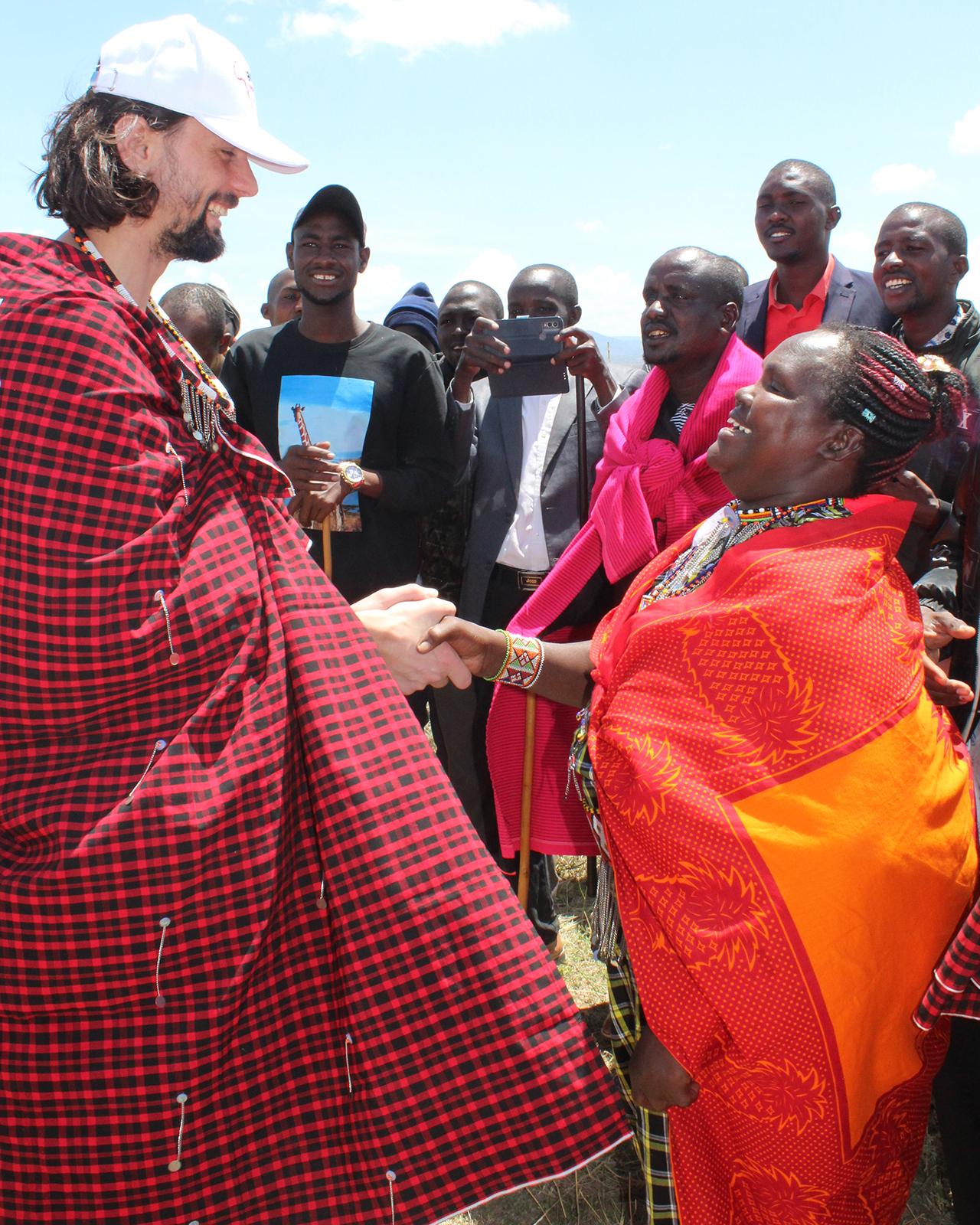
Neven Subotic’s foundation cooperates with GIZ through events, campaigns and the ’Sustainable Sanitation Alliance’. This international network, managed by GIZ, is committed to sustainable sanitation worldwide. It brings together experts from the fields of politics, academia, civil society and international cooperation, promotes exchange of knowledge and develops practical solutions. Neven Subotic likes to draw on this information frequently in his work, because the goals align, and ‘as a small foundation, we couldn’t build up a knowledge base like that on our own.’
GIZ contact: Fanni Zentai