A valuable harvest
Sustainable supply chains stabilise businesses. A visit to Ghana shows how GIZ supports smallholder farmers in the Global South while boosting the competitiveness of European companies.
Ghana has been satisfying the world’s sweet tooth for a long time. The West African country is the second largest cocoa producer in the world after Côte d’Ivoire. Ghana’s 800,000 smallholder farmers harvest valuable cacao pods every year. The beans are then sent in shipping containers, primarily to Europe. Up to 65 per cent of the country’s cocoa exports are to the European Union. They arrive at ports in Hamburg and Rotterdam and are distributed from here.
Germany is the largest producer of chocolate products in the EU. The confectionery industry therefore needs an appropriate amount of cocoa. In fact, 60,000 jobs depend on it directly.
A turning point for the cocoa industry
German companies rely on stable and sustainable supply chains to remain competitive. But how can sustainable cocoa production be verified? Ghana achieved a breakthrough in the 2025/26 harvest season: the new Ghana Cocoa Traceability System (GCTS) tracks the journey of every cocoa bean seamlessly – from the moment farmers cut the cacao pods from the trees up until the beans are unloaded at the ports.
was the value of chocolate products containing cocoa produced in Germany in 2024.
Source: destatis
The journey of a cocoa bean
Use the links to find out more about the sustainable supply chain that leads to supermarket shelves in chocolate-loving Germany.
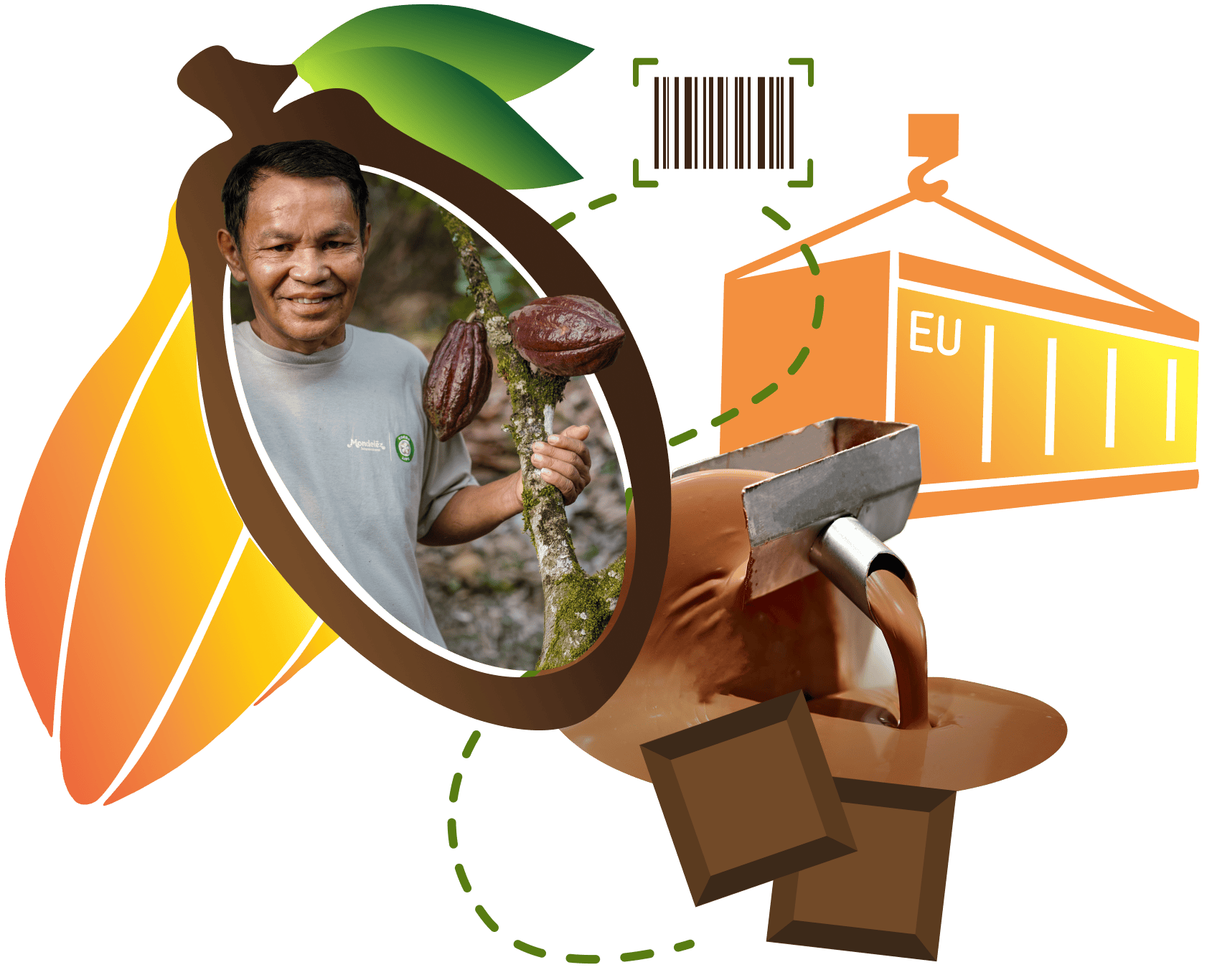

It begins on cocoa fields
A cocoa bean’s journey begins with the five to six million smallholder farmers who cultivate the fruit around the equator in what is known as the cocoa belt: stretching from Latin America to West Africa and South-East Asia. People like Luther from Indonesia. If we want to protect forests and ensure fair incomes, we need to support cocoa farmers systematically. This is precisely the goal of the Team Europe Initiative on deforestation-free supply chains, which GIZ is committed to. The Initiative is financed by the EU, BMZ, the Dutch Ministry of Foreign Affairs and the French Ministry of Ecological Transition.

Cooperatives make producers stronger
Local cooperatives play an important role in the next step. They are the lever that makes small cocoa farms strong trade partners. To facilitate market access, GIZ brings together actors along the supply chain. In the Democratic Republic of the Congo, for example, 20 cooperatives have been established – despite the volatile situation. They count 15,000 small cocoa producers as members. The cooperatives allow them to sell their beans directly to companies in Belgium, Germany, the Netherlands and France. This type of direct sales is quite unusual.

Ghana is making its cocoa supply chain transparent
How can reliable evidence of sustainable cocoa production be provided? In the 2025/26 harvest season, Ghana established the new central system for seamless cocoa traceability – the Ghana Cocoa Traceability System (GCTS). It provides transparency, and this is becoming more and more important for exports to the EU. The Ghana Cocoa Board, which is the government umbrella body for cocoa in Ghana, received support with nationwide implementation from GIZ. With the GCTS, the West African country is showing how important it is for cocoa-producing states to implement reforms that benefit local small farms. This not only boosts competitiveness and export access; it also improves the incomes of the farms in the long term.
The Sustainable Cocoa Initiative – International Partnerships

From small farms to the global market
It is rare for small cocoa farmers to be able to sell directly to processing companies abroad. This is why the next step is performed by raw materials traders like Olam Food Ingredients (ofi), one of the world’s largest distributors of cocoa beans and cocoa products such as cocoa powder and cocoa butter. The company is a key private-sector actor in the cocoa industry. ofi is committed to building a resilient, transparent and ethical supply chain that ‘benefits both people and the planet’. In the long term, this sustainable approach ensures supply and the necessary quality for the cocoa traders. GIZ works with ofi in development partnerships: projects are designed and implemented jointly and financed fifty-fifty by the private sector and the public sector.

Where cocoa becomes chocolate
Germany is the largest producer of chocolate products in the EU. It is here that the ground cocoa beans are processed, and chocolate is produced for consumption in Germany and for export. The German Federal Government, chocolate companies, retail and civil society have united in the German Initiative on Sustainable Cocoa (GISCO) and are working together for a sustainable cocoa sector. The GISCO Secretariat is coordinated by GIZ. For Chairman of the Board Aldo Cristiano (Ferrero Deutschland GmbH), the Initiative stands for dialogue, joint efforts for viable solutions and shared responsibility among members. In the long term, sustainable cocoa supply chains secure the supply of raw materials and create jobs in the confectionery industry.

Buying responsibly
Once they leave the chocolate manufacturers, the sweet treats find their way to retail shelves. However, the continued supply of cocoa can no longer be taken for granted: harvests are becoming increasingly unreliable due to climate change, and many farming families are giving up their work. As a result, the supply chain for chocolate is in jeopardy. Traders and manufacturers are responding. dm-drogerie markt, chocolate manufacturer Maestrani, Fairtrade Deutschland and Fairtrade Africa are working together with GIZ for sustainable improvements to the incomes of cocoa farmers in Sierra Leone, so that those who cultivate cocoa also benefit from the sale of chocolate and can improve their living situations. By buying organic chocolate bars at dm, consumers are supporting the environment and the people along the entire supply chain. For its company-wide commitment, dm received the Fairtrade Award in 2024 and has been nominated again in 2026 for this project.
The system in Ghana pools data on farmers, harvest yields and transport routes across the country – through GPS mapping, barcodes and mobile data collection. It can thus provide reliable verification that businesses are meeting standards for ethical working conditions and protecting tropical forests. Furthermore, it connects the farmers more directly via digital identification: they have better access to seedlings, receive advice on environmentally friendly cultivation methods and can register for a pension scheme run by the Ghana Cocoa Board.
From a patchwork concept to a reliable solution
Previously, many traders and importers used their own various systems. Often with such systems, cocoa could be traced back only to a particular cooperative, and not to its cultivation on the field. To change this, GIZ supported the government umbrella body for cocoa in Ghana in implementing the Ghana Cocoa Traceability System. Implementation was part of the Sustainable Cocoa Initiative – a Global Gateway initiative of the European Union.
in private-sector funding was successfully mobilised by SASI.
Platform for global agricultural supply chains
The cocoa example shows how GIZ is working to strengthen sustainable partnerships with producers in the Global South and thus make supply chains future-proof. To achieve this, it set up a central platform in the agricultural sector: the Sustainable Agricultural Supply Chains Initiative (SASI). This brings together business, policy-making and civil society – which often operate in parallel in agricultural supply chains. The network comprises 940 partners worldwide. Whether for cocoa, coffee, cotton, palm oil or rubber – joint approaches are formed that combine sustainability, resilience and economic viability.
The platform is financed as part of Germany’s international cooperation – in particular by the German Federal Ministry for Economic Cooperation and Development (BMZ); and by additional partners, depending on the project. Public funding and private capital complement each other.
The SASI platform ensures transparency and reliable partnerships for all involved, whether in Ghana or Germany. When the journey from tree to ports in Europe is traceable, a valuable harvest becomes more than a raw material: it becomes the foundation for better prospects locally and for stable business transactions and reliable supply relationships across continents.

The Sustainable Agricultural Supply Chains Initiative (SASI) works to ensure that important agricultural commodities can be procured reliably and sustainably. It focuses not only on trade, but also on social and ecological challenges in the countries of origin. Together with its partners, SASI translates European standards into concrete improvements locally.
With networks in more than 60 countries, SASI gives companies access to specialist know-how, regional expertise and market knowledge. This makes it easier to tap new markets and reduce risks for investment.
SASI also brings together central actors along the supply chain at one table: companies, producer organisations, NGOs and governments. It provides support with practical know-how and digital solutions – so that supply chains are traceable and sustainable, and high-quality raw materials are available. Crop yields and incomes thus increase and agricultural products can be produced without deforestation.
Contact: Moritz Heldmann