
‘Entrepreneurship and social responsibility go together’
Sustainable business practices are vital for our future. Philanthropist and entrepreneur Michael Otto discusses this principle in an interview and explains why the Global South is crucial for Germany.
Mr Otto, you are an entrepreneur and have also set up several foundations that focus on sustainability and democracy. What drives you?
I am driven by the firm belief that businesses are an important part of society and therefore carry a great deal of responsibility. For me, entrepreneurial freedom and social responsibility are inextricably linked. I try to put this into practice through my work in foundations like the Aid by Trade Foundation, the Umweltstiftung Michael Otto, the Michael Otto Foundation for Sustainability and Stiftung KlimaWirtschaft – German CEO Alliance for Climate and Economy.
My commitment to sustainability is not a product of the ‘zeitgeist’ but a personal conviction that developed in me as early as the 1970s, and which I consider to be an essential requirement for responsible entrepreneurship. It has always been important to me to help shape long-term solutions, promote dialogue and assume responsibility in areas where we have scope for action.
You are also a co-initiator of the Hamburg Sustainability Conference. In your view, what responsibility do businesses have when it comes to achieving the UN’s Sustainable Development Goals (SDGs)?
The private sector has benefited substantially from globalisation. Ignoring the principles of sustainable business threatens this success and endangers the future of our planet. Businesses should therefore have a strong interest in achieving the SDGs. They also have every capability to be part of the solution: innovate strength, the power to shape change, and transformation capacity.
What matters is that sustainability is established as a viable business model – including for a company’s own operations – and that responsibility is taken seriously, even when it is inconvenient. Voluntary commitment is important, but is often insufficient; clear political guidelines can accelerate sustainable action. They also create fair conditions for competition, so that decisions that promote sustainability are not at odds with company profits.

How important is the Global South for the German and European economies?
Very important. Many of our raw materials and primary products originate from partner countries in the Global South; this is also where the growth markets of the future are to be found. So it would be a mistake to believe that less investment in international cooperation would result in more wealth for us. We need stable relationships at the international level in order to secure our economic foundation. The various crises and wars that are currently unfolding are making us acutely aware of this. We must not be indifferent to what is happening in Africa, for example. Sustainable, partnership-based relationships in the Global South are important for us strategically and economically.
Recently, there have been increasing calls to align development policy more closely with Germany’s (economic) interests. Where do you stand on this?
Systemic changes that benefit people and the environment can only be achieved by pooling the strengths of the private sector, policy-makers and civil society. Sustainable development in countries in the Global South creates framework conditions that directly benefit our economy – through reliable supply chains, a skilled workforce and new markets, but also through improved societal relations that prevent the causes of migration. Organisations like GIZ build bridges here: they offer knowledge on the local situation, trust-based relationships and political experience, while businesses contribute investment, innovation and implementation strength. It is about consistently aligning economic interests with shared values and thus creating win-win situations. An example of this is the Otto Group’s cooperation with GIZ and the Textile Dialogue (formerly the Textile Partnership). Together, we support circular processes in countries of the textiles supply chain. These partnerships combine economic benefits with global responsibility.
What possibilities does the Hamburg Sustainability Conference offer for this type of cooperation?
The conference is an important forum for dialogue between the private sector, policy-makers, academics and civil society. We come together as equals to jointly develop solutions for global challenges – whether it is for sustainable supply chains, climate action or social participation – and set about implementing them. International dialogue is crucial to build trust, pool expertise and facilitate partnerships that combine economic innovative capacity with development policy experience and global responsibility. Only through this dialogue can we come up with viable, forward-looking concepts.
Another question about the UN SDGs: 2030 is no longer far away – what does this mean from your perspective?
It is especially important to me that we finally act more decisively and do more than just talk. Credibility is built through action – not through words. Time is running out, and the consequences of inaction would affect generations to come. We now really need to push ahead with climate action, environmental protection and social participation. At the same time, as an entrepreneur I have learned that big goals require perseverance. It is important to shape the present purposefully while creating the foundation for long-term success.
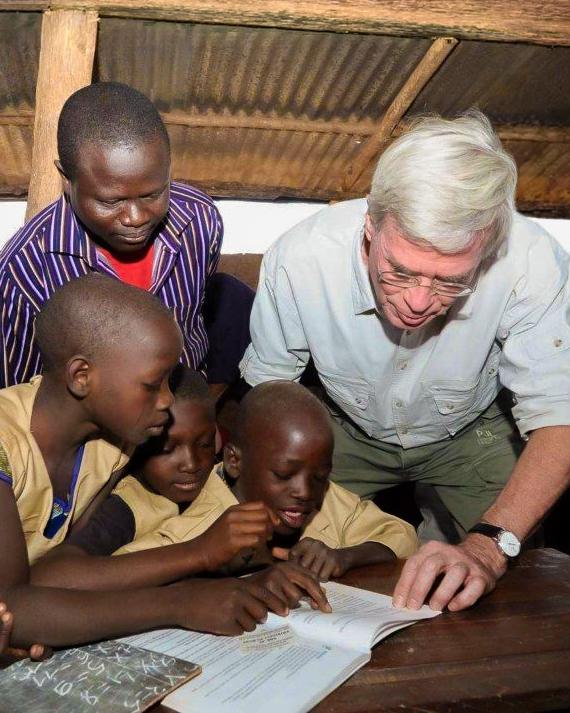
Professor Michael Otto is a German entrepreneur and long-standing chairman of the management and supervisory boards of the Otto Group. He is regarded as a pioneer for sustainable business. Under his leadership, the Otto Group became one of the first major retail groups to systematically integrate environmental and social standards into its business processes. Since withdrawing from operational business, Michael Otto has stepped up his work in various foundations for environmental protection, climate action and social responsibility, which he himself established. As a co-initiator of the Hamburg Sustainability Conference, he also drives global dialogue aimed at developing concrete solutions for the UN SDGs and improving international cooperation.


